

Rippling in 2025: What 100-500 Employee Companies Need to Know
The all-in-one HRIS play: what Rippling does well, where it gets complicated, and whether the "compound startup" pitch fits your stage.
by
Sponsored Feature
Somewhere between 100 and 500 employees, HR operations hit an inflection point. The scrappy tools that worked at 30 people—a basic payroll service, spreadsheets for tracking equipment, separate logins for benefits and time tracking—start creating more work than they save. Every new hire means updating five systems. Every departure means chasing down laptops, revoking access across a dozen apps, and hoping nothing falls through the cracks.
For mid-market HR teams, often just two or three people managing hundreds of employees, the question becomes: do you hire more admins to handle the administrative sprawl, or find a way to consolidate? Most companies don't have the budget or desire to staff up just to manage systems. They need fewer tools doing more, with automation handling the repetitive work.
Rippling was founded in 2016 with a specific bet: that employee data should live in one place and flow automatically to every system that needs it. Rather than building just an HRIS or just a payroll tool, the company created what it calls an "Employee Graph"—a unified data model that connects HR, IT, and finance functions.
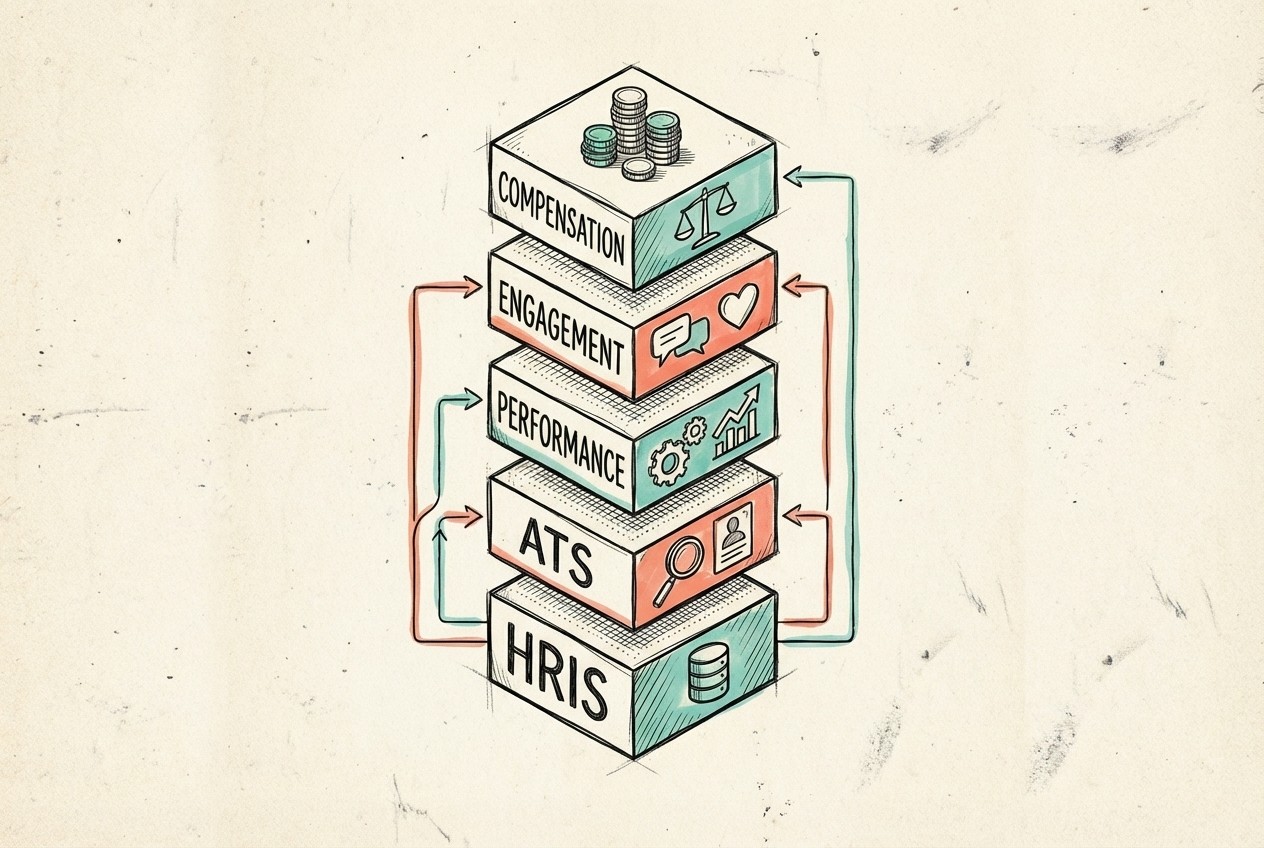
In practice, this means when you hire someone in Rippling, that single action can trigger offer letters, payroll setup, benefits enrollment, laptop provisioning, and account creation across your software stack—all without manual re-entry. The platform includes core HR and payroll, benefits administration, time and attendance, an applicant tracking system, and performance management. But it also extends into territory most HR platforms don't touch: device management, single sign-on, corporate cards, and expense management.
The integration layer is substantial. Rippling connects with over 600 third-party applications, from Slack and Google Workspace to Greenhouse and QuickBooks. For companies running on modern SaaS tools, this means employee data stays synchronized without custom integrations or CSV exports. A Workflow Automator lets admins create conditional rules across modules—automatically notifying IT when someone in Sales resigns, for example, or triggering a compliance checklist when an employee transfers to a new state.
What distinguishes Rippling from traditional HR software is this cross-functional scope. Most HRIS platforms handle people data well but leave IT and finance as separate domains. Rippling treats them as interconnected, which resonates particularly with companies where a small team wears multiple hats and needs systems that talk to each other.
Rippling's customer base skews toward companies with 50 to 500 employees, with a particular concentration in the 100 to 300 range. These are typically fast-growing organizations—often Series A through Series C startups—that have outgrown basic payroll providers like Gusto but aren't ready for enterprise systems like Workday.
The platform tends to appeal to tech-forward companies with significant SaaS footprints, though its customer roster spans industries: Five Guys, Barry's fitness studios, Anthropic, Notion, and Crumbl Cookies all appear on the client list. Companies with distributed teams or international employees find value in Rippling's global payroll and employer-of-record services, which now cover 80 countries. The common thread isn't industry—it's complexity. If your HR team is managing multiple vendors, struggling with manual handoffs between systems, or spending hours on tasks that should be automated, that's the profile Rippling was designed for.
Customer reviews consistently highlight two themes: consolidation and time savings. Morning Consult, a 500-employee firm, reports that switching to Rippling allowed a two-person HR and IT admin team to scale headcount by over 300 while cutting payroll processing time by 84 percent. The company estimates it saved 500 hours annually in administrative work and avoided hiring three additional staff.
On G2, where Rippling holds a 4.8 rating across nearly 12,000 reviews, users frequently cite the unified experience. One reviewer described it as "a one stop shop for all things HR—benefits, pay, PTO, and leave all under one umbrella." Others praise the interface as intuitive compared to legacy systems, with one noting that employees "didn't even need a training session" to use it. The platform earned G2's top ranking for HR software in 2025. Customer critiques, when they appear, tend to focus on pricing complexity and the learning curve required to fully utilize the platform's breadth—a function of having so many capabilities in one system.
Rippling uses modular, per-employee-per-month pricing with annual contracts. The base HRIS starts around eight dollars per employee monthly, but most mid-market deployments using HR, payroll, and benefits run in the $21 to $29 range. Adding modules like device management or the ATS increases costs proportionally. For a 100-employee company using the full HR and IT suite, total costs typically land between $25 and $40 per employee per month.
Implementation timelines run four to eight weeks for standard deployments, with Rippling providing onboarding specialists for mid-market accounts. The company offers self-service training through "Rippling University" and maintains a robust help center, though larger customers generally receive dedicated customer success support.
For HR teams at mid-sized companies managing growing complexity with limited staff, Rippling offers a genuine consolidation play—not just another HR tool, but a platform that connects people operations, IT provisioning, and spend management in a single system. It's priced at a premium compared to simpler alternatives, but the value proposition is reducing the vendor sprawl and manual work that accumulates as organizations scale.
Learn more at rippling.com