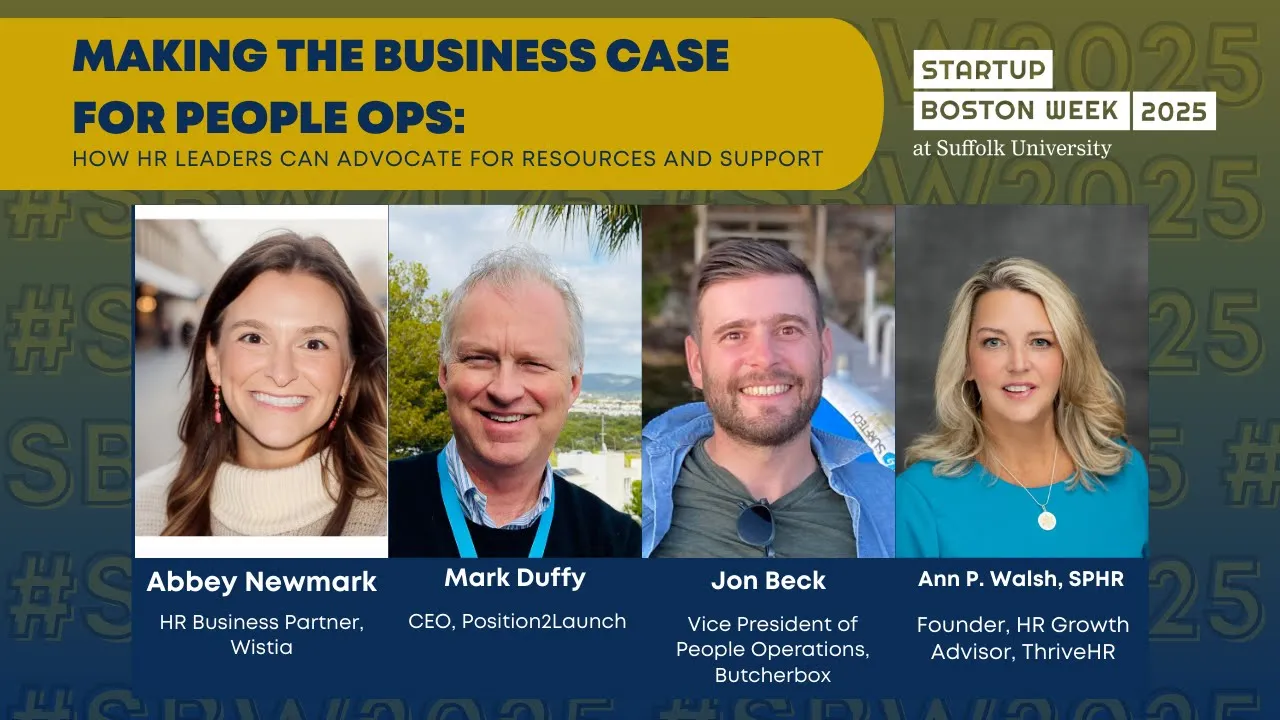


Making the Business Case for People Ops: How HR Leaders Can Secure Resources and Support
How to pitch headcount, tools, and budget to leadership when you're not a revenue center. Frameworks and talking points that actually work.
by
In the high-stakes world of early-stage startups, the focus is almost exclusively on product-market fit and runway. "Human Resources" is often relegated to a folder of offer letter templates or viewed as a bureaucratic function to be hired only when the team hits 50 people.
However, a recent panel at Startup Boston Week, titled "Making the Case for People Ops," dismantled this outdated view. Featuring leaders from Position to Launch, ButcherBox, and Thrive HR, the discussion highlighted a critical reality: People Ops is not a cost center; it is the circulation system of your company.
Here is why modern founders need to stop viewing HR as administrative overhead and start leveraging it as a strategic growth engine.
One of the most compelling arguments for early HR intervention came from the finance side of the table. Mark Duffy, CEO of Position to Launch, framed hiring through the lens of financial survival.
In a seed-stage company, your runway is finite. If you spend three months recruiting a Head of Engineering, four months onboarding them, and three months realizing they are the wrong fit, you haven't just lost an employee. You have burned eight to ten months of capital and product development time.
For a startup with an 18-month runway, a single bad hire in a critical role is an existential threat. Strategic People Ops isn't about "filling seats"; it’s about risk mitigation. Implementing rigorous hiring standards and cultural alignment checks early on protects the company's most valuable asset: time.
There is a historic tension between Finance (who controls the budget) and HR (who wants to spend it). John Beck, VP of People at ButcherBox, and Anne Walsh of Thrive HR emphasized that this silo must be broken immediately.
To advocate for resources, HR leaders must learn to speak the language of the business. You cannot simply ask for a budget for "employee engagement" because it sounds nice. You must tie it to Business Improvement Goals (BIGs).
The wrong pitch: "We need a budget for a manager training program."
The right pitch: "Our data shows attrition is highest under new managers. Replacing those employees costs 1.5x their salary. A $20k investment in coaching will save us $150k in replacement costs this year."
When People Ops aligns its initiatives with financial outcomes—reducing turnover costs, mitigating legal risk, and accelerating productivity—the CFO becomes a partner, not a gatekeeper.
In the era of HR Tech, we have access to more data than ever. However, data without context is just noise.
John Beck shared how ButcherBox utilizes tools like Workday and Peakon not just to track eNPS (Employee Net Promoter Score) scores, but to capture the employee voice. While quantitative data tells you what is happening (e.g., retention is down), qualitative data (comments and feedback) tells you why.
Successful People Ops uses storytelling to humanize the data. When presenting to the board or executive team, combine the metrics with the narrative. It bridges the gap between cold spreadsheets and the human reality of the workforce, making the case for investment undeniable.
It’s not the sexy part of startups, but compliance is the foundation of scalability. As Anne Walsh noted, many founders operate on "handshake deals" regarding equity or roles.
This works fine until you attempt to raise a Series B or go through an acquisition. During due diligence, a lack of proper offer letters, undefined IP ownership, or misclassified contractors can devalue—or even kill—a deal.
People Ops ensures that the company’s "corporate hygiene" is pristine. It’s not red tape; it’s ensuring that the value the founders are building is legally protected and transferable.
Finally, the panel touched on the elusive concept of "culture." It is not about Friday drinks or ping-pong tables. Culture is how decisions are made when the CEO isn't in the room.
If you wait until you have 50 employees to define your values, you are too late. Your culture will have already defined itself, likely in ways you didn't intend.
Strategic People Ops helps codify these values early. They ensure that you aren't just hiring for "culture fit" (which can lead to bias and homogeneity), but for "culture add"—bringing in people who align with the mission but bring new perspectives to challenge and grow the business.
If you are a founder or an HR leader in a startup, the message from Startup Boston is clear: Do not wait.
Whether it is implementing a weekly pulse survey, investing in executive coaching for your A-players, or simply ensuring your compliance house is in order, investments in People Ops yield compound returns. As Mark Duffy eloquently put it, if you view your company as a body, Finance might be the brain, but HR is the heart and circulation. You can't survive without it.